
Adult education in England is publicly funded, and most people who qualify have never been told. In 2026/27 you can usually get a fully funded course if you are 19 or older and earn under £26,800 a year. Unemployed people and those on certain benefits usually qualify too. This guide explains who pays, who qualifies, and why your postcode changes what you can study for free.
Who can get a government funded course in 2026/27?
You are likely to qualify for a fully funded course if you live in England, are 19 or older, and earn under £26,800 a year. People who are unemployed or on certain benefits usually qualify too. The course provider confirms eligibility when you enrol.
The £26,800 figure is the national earnings threshold for courses starting from 1 August 2026. The Department for Work and Pensions states: “We have increased the earnings threshold from £25,750 to £26,800.”
Some areas set a higher cut off. In London the threshold is £28,860. In Buckinghamshire a first full Level 3 course is funded up to £31,427. More on this below.
Is there an age limit on funded courses?
There is no upper age limit. Funding applies whether you are 25, 40, 50 or older. The rules set a minimum only. To be funded as an adult learner you must be “aged 19 or older on 31 August within funding year 2026 to 2027”.
Support for under 19s runs through a separate school and college system. Everything on this page is about adults.
What can you study for free?
The funded offer is wider than most people expect. It includes:
- A first full Level 2 or Level 3 qualification. Level 3 is the same level as A levels. Adults who do not already hold one can study free through the Free Courses for Jobs offer. If you earn under the threshold or are out of work, you can qualify even if you already have a Level 3.
- English, maths and digital skills. Free for adults without a GCSE grade 4 or equivalent, with no earnings test. That includes GCSE resits and Functional Skills courses.
- ESOL courses for adults whose first language is not English.
- Sector training with extras. From August 2026 the rules fund a CSCS card application fee and the health and safety test for construction learners. Skills Bootcamps offer short, job focused training in priority sectors.
Browse free courses across England or search the full course directory to see what is running near you.
What changed in 2026/27?
Three national changes took effect for courses starting from 1 August 2026:
- The earnings threshold rose to £26,800, up from £25,750 last year.
- Free Courses for Jobs expanded. The rules now include “level 2 qualifications in the engineering and manufacturing sectors”.
- Construction cards became fundable. Providers can claim “the cost of a construction skills certification scheme (CSCS)” card fee and the associated health and safety test.
One thing did not change much. The threshold rose 4.1%, but average pay rose about 4.3% over the same period. Roughly the same share of workers qualifies as last year.
Who pays for adult education in England?
The Department for Work and Pensions owns the main budget, called the Adult Skills Fund. Responsibility “transferred from the Department for Education (DfE) to the Department for Work and Pensions (DWP) on 16 September 2025”.
No total national budget has been published. It can be worked out, though. Liverpool City Region’s published allocation is £56,495,951, which its committee papers state is 3.99% of the national budget. That implies a national Adult Skills Fund of roughly £1.42 billion.
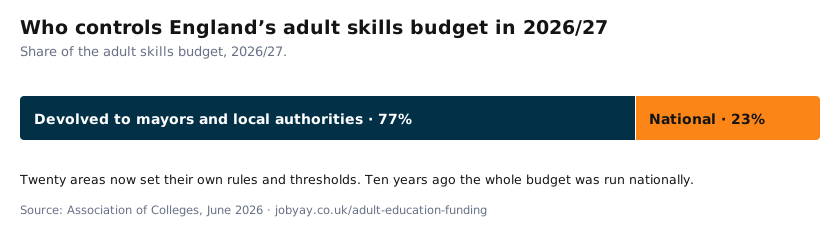
Around £1 billion of that is now controlled locally. Twenty mayoral and combined authorities receive their own allocations and set their own rules. The Association of Colleges estimates that around 77% of the adult skills budget is devolved in 2026/27. It reports spending of £1,310 million in the 2025/26 academic year. The rest of England runs on the national DWP rules.
Embed this chart on your site
Copy the code below. Free to reuse with the credit link.
The budget is under pressure. The Association of Colleges reports that national adult skills allocations fell from around £450 million in 2025/26 to around £320 million in 2026/27. Most of that fall reflects transfers to newly devolved areas. The AoC also notes that “there has been no public announcement on the total adult skills budget”.
How much does your area get?
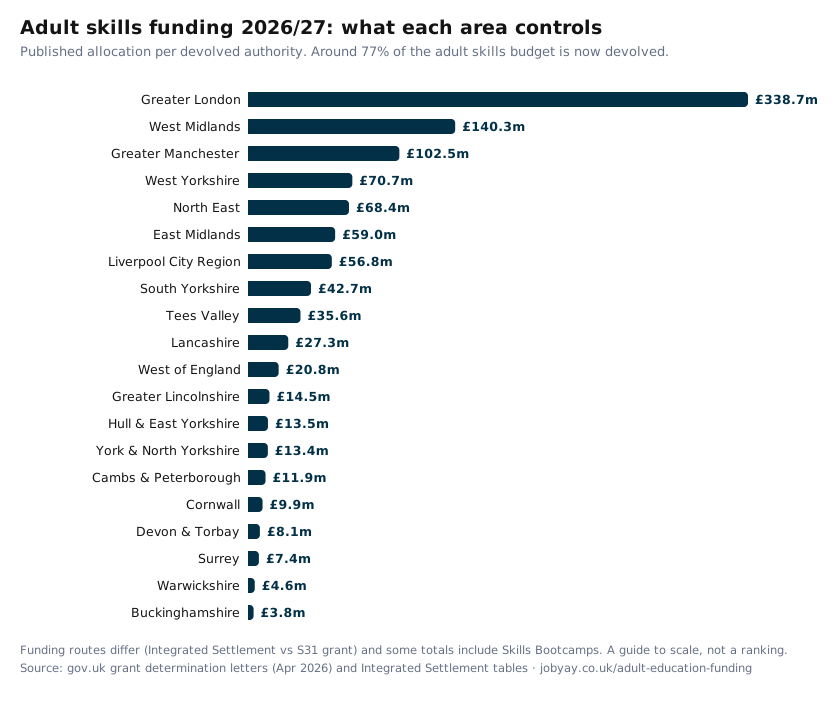
These are the published 2026/27 adult skills allocations for every devolved authority in England. No other public source brings them together.
Embed this chart on your site
Copy the code below. Free to reuse with the credit link.
| Authority | 2026/27 adult skills allocation |
|---|---|
| Greater London | £338,703,290 |
| West Midlands | £140,343,486 |
| Greater Manchester | £102,539,086 |
| West Yorkshire | £70,686,274 |
| North East | £68,407,762 |
| East Midlands | £59,034,476 |
| Liverpool City Region | £56,783,451 |
| South Yorkshire | £42,678,960 |
| Tees Valley | £35,552,817 |
| Lancashire | £27,282,065 |
| West of England | £20,757,671 |
| Greater Lincolnshire | £14,541,352 |
| Hull and East Yorkshire | £13,518,546 |
| York and North Yorkshire | £13,448,496 |
| Cambridgeshire and Peterborough | £11,881,548 |
| Cornwall | £9,866,186 |
| Devon and Torbay | £8,058,610 |
| Surrey | £7,385,923 |
| Buckinghamshire | £3,787,824 |
| Warwickshire | £4,574,370 |
Figures come from the government’s grant determination letters (21 April 2026) and the Integrated Settlement tables for 2026/27. The two funding routes package money differently, so treat the table as a guide to scale, not a ranking. Some totals include Skills Bootcamps; financial year and academic year figures also differ.
Why does your postcode change what is free?
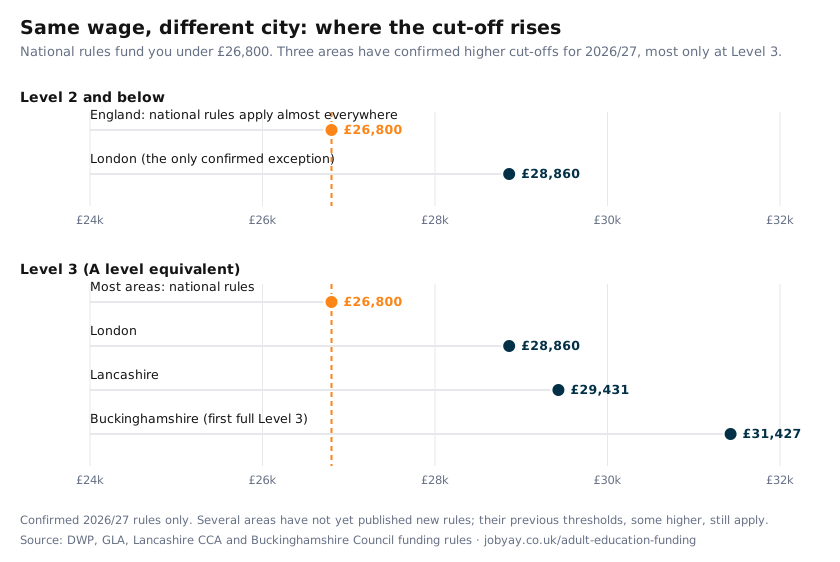
Skills funding is devolved. Each authority can set its own earnings threshold and fund extra things the national rules do not. Two people on the same wage in different cities can have different free course entitlements.
The national £26,800 cut off applies almost everywhere. So far, London is the only area to confirm a higher cut off for all course levels in 2026/27. Lancashire and Buckinghamshire raise theirs for Level 3 courses only.
Embed this chart on your site
Copy the code below. Free to reuse with the credit link.
Earnings thresholds confirmed for 2026/27 so far:
| Where you live | Fully funded if you earn under |
|---|---|
| England (national rules) | £26,800 |
| London | £28,860 |
| Buckinghamshire | £26,800 (£31,427 for a first full Level 3) |
| Lancashire | £26,800 (£29,431 for Level 3 courses) |
| West Yorkshire, York and North Yorkshire, Hull and East Yorkshire, Greater Lincolnshire, West of England | £26,800 |
Several authorities, including Greater Manchester, the West Midlands and Liverpool City Region, had not published their 2026/27 rules when this page was last updated. Their previous thresholds still apply until new rules appear, and some are higher than the national figure. The quickest way to find out what applies to you is the eligibility checker, which uses your postcode.
Local extras already confirmed for 2026/27 include:
- A Care Leavers’ Support Fund in Greater Lincolnshire.
- Funded Level 4 courses for lower earners in London.
- Higher funding rates for English, maths and ESOL courses in the West of England.
Where does this data come from?
Every figure on this page comes from a published official document: the DWP funding rules, government grant determination letters, Integrated Settlement tables, or the authority’s own funding rules and committee papers. Nothing is estimated except the £1.42 billion national figure, which is arithmetic from Liverpool City Region’s published numbers and labelled as such.
We maintain this page as a reference. Sources are re-checked monthly and after each authority publishes new rules, and past versions are archived so year on year changes can be tracked. If you spot an error or your organisation has published new rules, email [email protected].
How much of this funding actually gets used? Our study The Free Training Blind Spot maps who qualifies for free training and who enrols, region by region.
You are welcome to cite or link to this page. Please credit JobYay and link back so readers can find the current figures.
Sources: DWP Adult Skills Fund funding rules 2026 to 2027 (updated 16 June 2026), Adult Skills Fund grant determination letters (21 April 2026), Integrated Settlement funds 2026 to 2030 (updated 18 December 2025), plus each authority’s own published 2026/27 funding rules.
Page last updated: 12 August 2026. Figures apply to the 2026/27 funding year (1 August 2026 to 31 July 2027).